 Skip to content

Home » Ischemic Wound
Ischemic Wound
Home » Ischemic Wound
Ischemic Wound
Home » Ischemic Wound
Ischemic Wound
What Is Ischemic Wound?
An ischemic wound is a type of injury that occurs when there’s insufficient blood flow to a part of the body, usually due to arterial blockage. This lack of circulation deprives tissues of oxygen and nutrients, leading to cell damage or death, and ultimately forming a wound that’s slow to heal or may not heal at all.
What Is Ischemic Wound?
An ischemic wound is a type of injury that occurs when there’s insufficient blood flow to a part of the body, usually due to arterial blockage. This lack of circulation deprives tissues of oxygen and nutrients, leading to cell damage or death, and ultimately forming a wound that’s slow to heal or may not heal at all.
Key Characteristics Location:
Commonly found on the legs, feet, and toes—especially on the shins, heels, and between the toes.
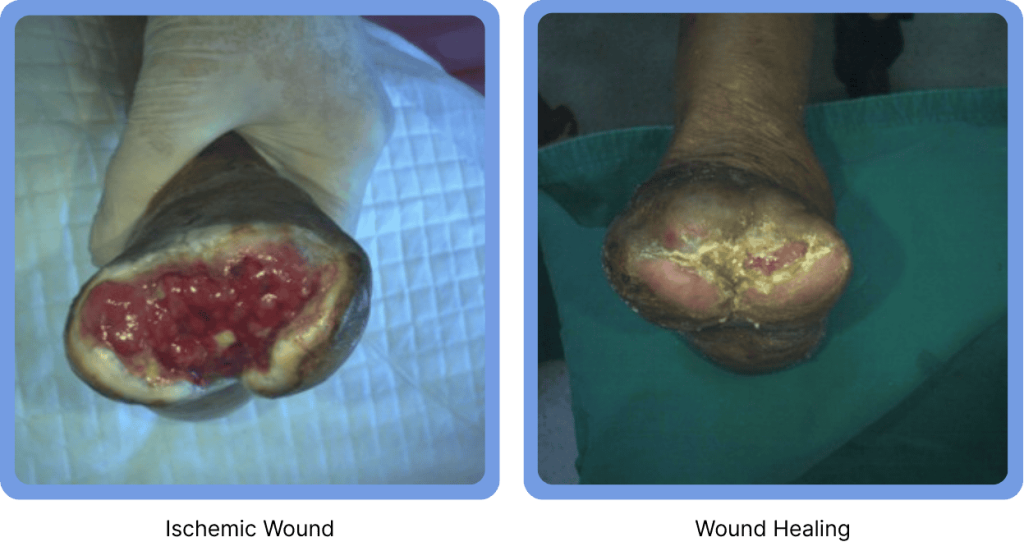
Appearance: These wounds often look punched out with raised edges, and may be dark red, yellow, gray, or black. They typically don’t bleed.
Pain: Often very painful, but pain may ease when the affected limb is dangled downward, as gravity helps blood flow.
Key Characteristics Location:
Commonly found on the legs, feet, and toes—especially on the shins, heels, and between the toes.
Appearance: These wounds often look punched out with raised edges, and may be dark red, yellow, gray, or black. They typically don’t bleed.
Pain: Often very painful, but pain may ease when the affected limb is dangled downward, as gravity helps blood flow.
Treatments
Shockwave Spark Wave® Therapy
- Can trigger transient activation of proinflammatory pathways
- Enhances cell proliferation by acting on ATP release.
- Leads to a cytoprotective response.
- Supports tissue regeneration.

Procellera
- Generate electricity designed to mimic the skin’s electrical energy.
- Demonstrated to kill existing biofilm and prevent biofilm from forming (in vivo pre-clinical model).
- Demonstrated to increase the rate of cell migration and re-epithelialization.

Treatments
Shockwave Spark Wave® Therapy
- Can trigger transient activation of proinflammatory pathways
- Enhances cell proliferation by acting on ATP release.
- Leads to a cytoprotective response.
- Supports tissue regeneration.
Procellera
- Generate electricity designed to mimic the skin’s electrical energy.
- Demonstrated to kill existing biofilm and prevent biofilm from forming (in vivo pre-clinical model).
- Demonstrated to increase the rate of cell migration and re-epithelialization.
Shockwave Spark Wave® Therapy
- Can trigger transient activation of proinflammatory pathways
- Enhances cell proliferation by acting on ATP release.
- Leads to a cytoprotective response.
- Supports tissue regeneration.
Procellera
- Generate electricity designed to mimic the skin’s electrical energy.
- Demonstrated to kill existing biofilm and prevent biofilm from forming (in vivo pre-clinical model).
- Demonstrated to increase the rate of cell migration and re-epithelialization.
